
In many Hyderabad homes, a small, smooth black stone sits on the family altar. They worship it every day as a sacred form of Vishnu. Turn it in the light, and you may see a distinct spiral on its surface, crossed by fine radial lines.
To a palaeontologist, that spiral says something else entirely. The Shaligram shila preserves traces of an ancient ammonite, a coiled sea creature that lived roughly 150 million years ago in an ocean that no longer exists. The sediments containing these fossils were later lifted into the Himalayas, and the stones are collected from the Kali Gandaki river in Nepal.
In 2026, three adolescents at Blue Blocks Montessori School in Hyderabad learned to examine these stones as fossils. Then they took that knowledge into the homes of families who keep them. No laboratory machinery was involved, yet the work produced original cultural research, published with the teenagers as co-authors.
For anyone weighing up a school with innovation curriculum claims, this is the place to start.
What is the difference between STEM and innovation-based learning?
The difference lies less in the equipment or the subjects than in what children are asked to do with their knowledge.
A conventional STEM lesson might teach children how ammonites fossilised. An innovation-based investigation can begin with the same science and then ask students to frame a question no worksheet has already answered. The two overlap, but one repeats an explanation while the other investigates something new.
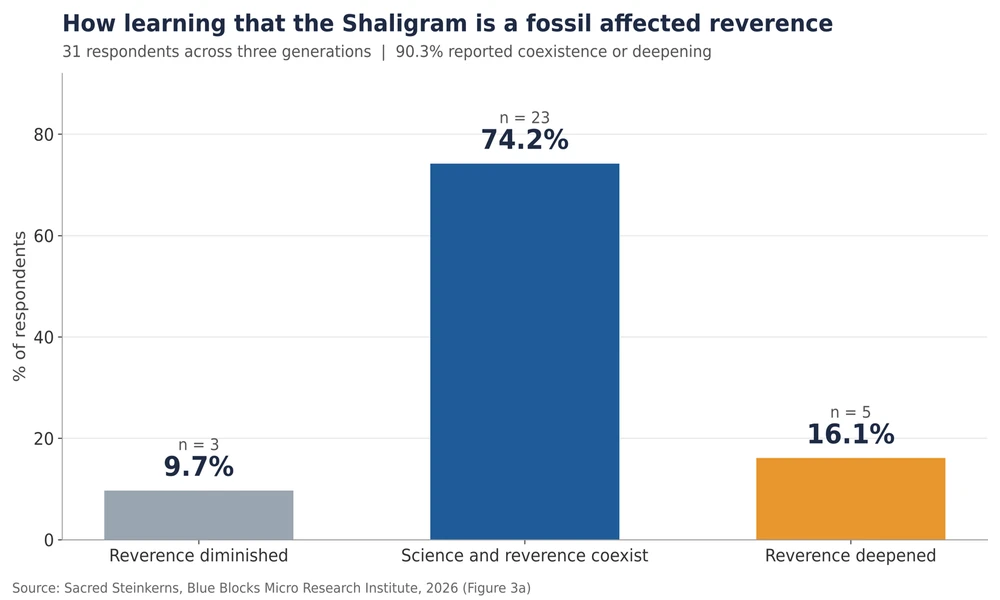
Guided by researchers at the Blue Blocks Micro Research Institute, the three adolescents interviewed 35 respondents across generations, and included 31 of those interviews in the analysis. They asked how families acquired their Shaligram, what it meant to them and whether they understood its fossil origin. The resulting study, Sacred Steinkerns, was co-authored with the Institute’s Research Head, Sreemoyee Chakraborty, and Dr Dhurjati Prasad Sengupta, a retired palaeontologist from the Indian Statistical Institute.
The finding complicated a familiar assumption. Among the 31 respondents, 90.3 per cent said that recognising the stone as a fossil did not reduce their reverence. It stayed the same or deepened. Scientific and cultural meanings could sit side by side, at least among these families.
Work like this shows what a school with innovation curriculum hyderabad families might hope for can look like in practice. Innovation need not begin with a new machine. It can begin with a question that connects geology, family tradition and evidence, and then lets the answer surprise everyone, including the students.
What are innovation labs and why are they important?
Innovation labs matter because they give children somewhere to test what they think they understand. A lab on its own proves very little. At an innovation lab school hyderabad parents can visit, the value lies less in the tools than in what students are asked to do when an attempted solution stops working.
In one documented workshop, twelve adolescents working in four teams of three faced a deceptively simple task: move water between containers without pouring it directly, using paper, tape, straws and scissors. The first attempts were expected to struggle, and they did. Paper channels leaked, and seals failed. The researchers watched what happened next.
All four teams treated the failure as a puzzle rather than an ending. Two teams drew, without prompting, on earlier science lessons about Archimedes’ principle and siphons. One student reached for a half-remembered demonstration: “Remember the thingy which we have in the science lab. The Greek guy thing.” A physical problem had called an old lesson back to mind.
Three of the four teams then returned to the instructions and noticed the brief allowed extra cups and materials that hadn’t been placed in front of them. Instead of accepting the apparent limits, they investigated them. Sometimes the breakthrough is discovering that a problem was never as narrow as it first seemed.
What is experiential learning in schools?
Families often assume that experiential learning in schools simply means learning through physical activity. Doing is not enough. An experience teaches most when children also examine what happened, what they assumed and what they might do differently.
Before the water challenge, the same adolescents had been asked to reflect privately on an earlier setback. Eight of the twelve returned written reflections, and some contained disappointment and doubt that were not visible the next day, when the same students threw themselves into the team challenge.
The two pictures were not contradictory. A student can carry real sadness from one setback and still show energy and adaptability in a new task. Watching the challenge alone would have missed what the written reflections revealed. The study, When Children Encounter Designed Adversity, is a qualitative case study of a two-day activity rather than a measure of lasting change, but it shows why reflection belongs inside experiential learning, not after it.
Choosing the right environment
The importance of innovation in school education is easy to market and harder to demonstrate. Every school can display a polished model. It is more revealing to ask what happens to the unfinished ones, the failed prototypes and the questions without immediate answers.
So make one request of every school you visit: show me a project that failed, and show me what the students wrote about it. Look for a child’s original question, a dated sketch, the first test, the unexpected result and the revision. Ask how mathematics, science or writing entered the investigation. A working model shows one kind of achievement, while the trail of decisions shows how the child got there.
At Blue Blocks Montessori School, the adolescent years, Classes 7 to 10, run at the Tellapur campus, where this work takes place alongside the Cambridge curriculum. Families interested in that approach to being a school with innovation curriculum can begin with an enquiry through the school’s admissions process.
Frequently asked questions
Does research work take time away from academic exams?
It need not. At Blue Blocks, students in Classes 7 to 10 also follow the Cambridge pathway, leading to IGCSE examinations in Classes 9 and 10. Research creates reasons to read closely, calculate accurately, write clearly and weigh evidence. Schools still need to plan time and ensure academic objectives are met.
Are these real research projects or just school assignments?
Both examples here became documented research, with adolescents contributing to published preprints. The Shaligram study analysed household interviews under researcher supervision, and the workshop used structured observation and private reflections. They are genuine investigations, though publication does not turn every finding into proof.
How do teachers assess students during group innovation challenges?
Guides observe how children frame a problem, discuss alternatives, use earlier knowledge, respond to setbacks and explain their decisions. Work journals, prototypes, reflection sheets and observation records make that thinking visible. The aim is to understand how a child reasons, not to grade the object they made.
Can younger children take part in this kind of work?
Yes, at a scale that suits them. Younger children can investigate a question about a plant, a household object or a family tradition, record what they find and explain it to others. The habits that make adolescent research possible, careful observation, honest recording and revision, start long before Class 7.
The project behind the photograph
An exhibition photograph shows what a student made. The notebook behind it shows what the student learnt. A school worth choosing is one that is proud to show you both.