
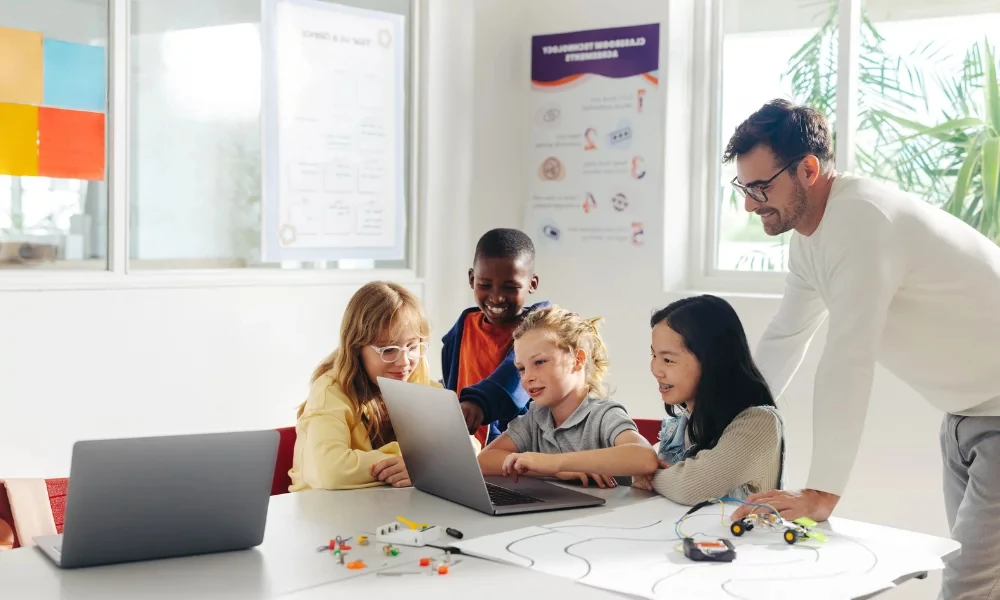
When people talk about technology in schools, the conversation often gravitates toward visible infrastructure: interactive boards, tablet programmes, robotics kits. These are the tangible, photographable dimensions of digital education, and they are genuinely important. But the most significant transformation happening in smart schools in Ahmedabad is not in the hardware. It is in the relationship between teacher, student, and knowledge that purposeful technology integration makes possible.
In a conventionally equipped classroom, the teacher delivers instruction to the group and receives feedback on understanding primarily through homework, tests, and the raised hands of confident students. The students who are confused, disengaged, or working well below or above the group’s level are often invisible to this system until a formal assessment reveals the gap. In a genuinely smart school in Ahmedabad, this invisibility is removed. Technology creates feedback loops that make every student’s understanding visible to the teacher in real time, enabling instruction that is genuinely responsive rather than delivered at the pace and level of the notional average student.
The Specific Ways Technology Is Changing the Classroom
The transformation in smart schools in Ahmedabad is visible across several dimensions of daily teaching and learning:
- Real-time formative assessment tools allow teachers to pose questions digitally, receive responses from every student simultaneously, and see immediately which concepts have landed and which require revisiting. This replaces the cold-calling and show-of-hands methods that systematically underrepresent the understanding of quieter or less confident students
- Adaptive learning platforms adjust the difficulty and content of practice material to each student’s demonstrated performance level, ensuring that practice time is always spent at the productive edge of a student’s capability rather than on material that is either too easy or too difficult
- Digital collaboration tools bring structure and accountability to group work that traditional group projects often lack, with version histories, individual contribution tracking, and shared workspaces that make the process of collaboration as educationally valuable as the product
- STEM and coding programmes develop computational thinking, logical reasoning, and the iterative problem-solving approach of engineering and design from the primary years onwards
- Blended learning environments that combine face-to-face teaching with digital resources, allowing students to revisit explanations, explore topics at greater depth, and learn at a pace that suits their individual processing speed
Technology and Inclusion
One of the less-discussed but most significant contributions of technology in smart schools in Ahmedabad is its impact on educational inclusion. Digital tools create multiple pathways to the same learning outcome, which means that students whose learning styles, pace, or language backgrounds place them at the margins of conventional instruction have more routes to genuine understanding.
Text-to-speech tools, visual and interactive content formats, multilingual resources, and the ability to pause, rewind, and revisit digital explanations all reduce the barriers that make conventional instruction inaccessible for some learners. A classroom that uses these tools well is one in which a wider range of students can genuinely participate in the learning.
What Smart Learning Infrastructure Looks Like Across the School
| Infrastructure Element | Primary Application | Learning Benefit |
| SMART interactive boards | Teacher-led visual instruction | Multimedia content, real-time annotation |
| Student devices and platforms | Individual and collaborative work | Personalised pace, digital skill development |
| STEM and robotics labs | Hands-on problem-solving | Computational thinking, engineering design |
| Learning management system | Assignment, feedback, and resource management | Organised learning, parent visibility |
| Digital library and research tools | Independent research and reading | Information literacy, source evaluation |
| Virtual and augmented reality | Immersive subject exploration | Conceptual depth, engagement |
The Teacher in a Technology-Rich Environment
Technology does not diminish the teacher’s role in a genuinely top cbse schools in ahmedabad . It changes its character. The teacher in a technology-rich classroom spends less time on information delivery, which digital resources can handle efficiently, and more time on the higher-order dimensions of teaching: facilitating discussion, coaching thinking, providing the kind of nuanced feedback that builds genuine capability, and attending to the social and emotional dimensions of learning that no technology can address.
This shift is educationally significant. The aspects of teaching that technology handles well, information presentation and basic practice, are also the aspects of least lasting value to students. The aspects that technology cannot handle, the human relationship, the motivating challenge, the sensitive identification of a student who is struggling, are precisely the aspects that are released to take centre stage when technology absorbs the lower-order work.
Preparing Students for a Digital World
The students learning in smart schools in Ahmedabad today will enter a future where technology is embedded in nearly every aspect of education, work, communication, and daily life. As a result, digital fluency is no longer an optional advantage but a fundamental skill. However, preparing students for this reality requires more than simply providing access to devices and software. It involves helping them develop critical thinking, digital responsibility, information literacy, adaptability, and the ability to use technology as a tool for problem-solving and innovation.
The most effective technology-driven learning environments balance digital resources with strong teaching practices, ensuring that technology enhances rather than replaces meaningful human interaction. By integrating technology purposefully across subjects and year groups, schools can create learning experiences that are more personalised, collaborative, and relevant to the challenges of the modern world. In doing so, they equip students not only to navigate a digital future but also to contribute to it with confidence, creativity, and responsibility.
——————————————————————————————————————————